
About JKPSC Assistant Registrar 2027 Exam Series
📖 Table of Contents
- JKPSC Assistant Registrar 2027 and the 2021 cycle in numbers
- What an Assistant Registrar actually does
- Who can apply for JKPSC Assistant Registrar 2027
- The selection process: 75 points written, 25 points interview
- The written paper: 120 questions, 2 hours, 0.25 negative marking
- The syllabus: five areas, one Act
- How to prepare the cooperative portion properly
- A 90 day plan that fits a single-paper exam
- Mistakes that cost candidates this exam
- Other exams worth preparing alongside JKPSC Assistant Registrar 2027
- Sources
JKPSC Assistant Registrar 2027: Cooperative Societies Exam Guide
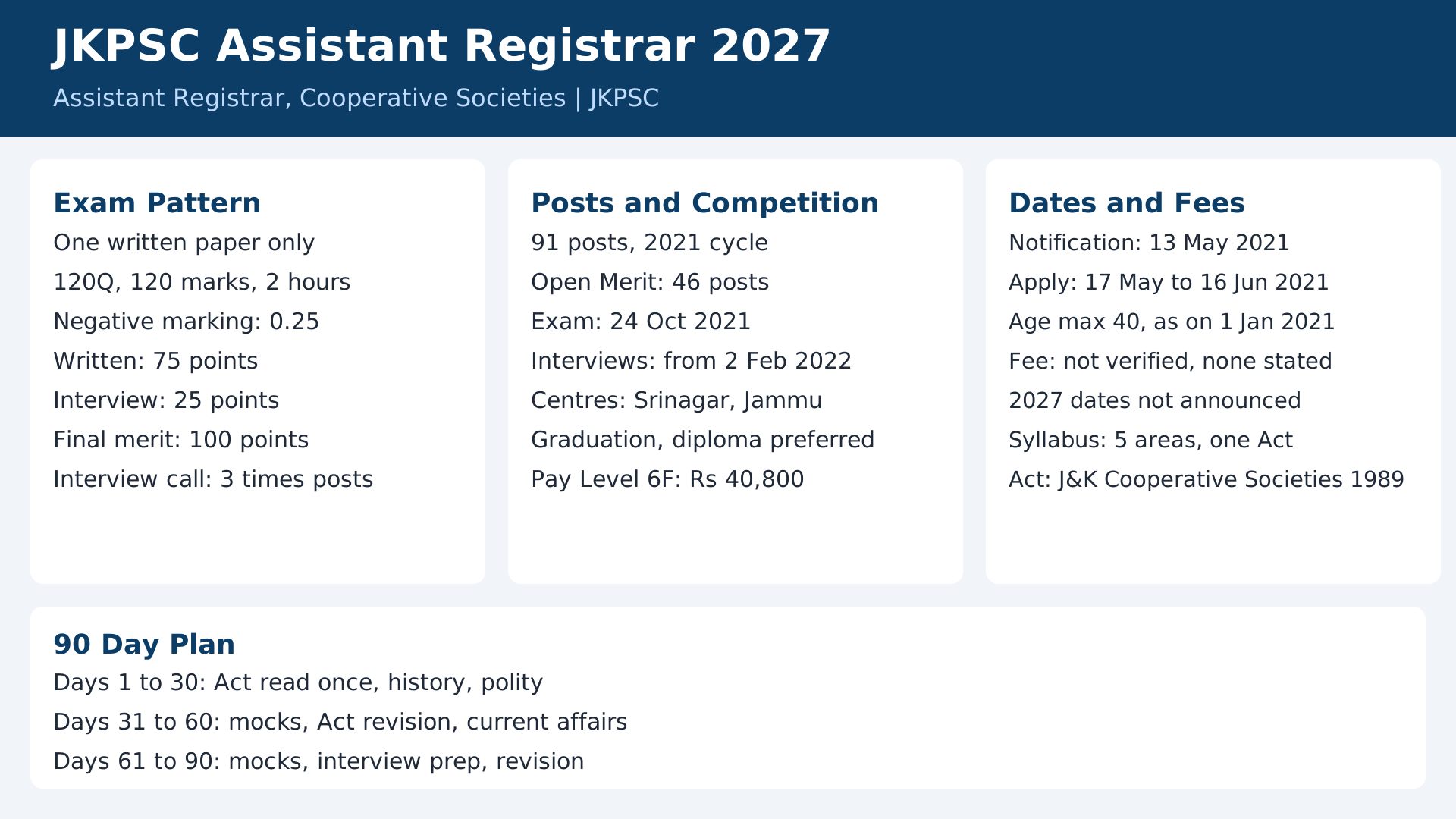
The Jammu and Kashmir Public Service Commission recruits Assistant Registrars for the Cooperative Societies wing of the Cooperative Department, and the latest cycle offered 91 posts. The notification came on 13 May 2021, applications ran from 17 May to 16 June 2021, the written examination was held on 24 October 2021, and interviews began on 2 February 2022. Selection runs through a written examination worth 75 points and an interview worth 25 points, for a total of 100. JKPSC Assistant Registrar 2027 has no notification yet as of 20 November 2026, so every fact in this guide comes from that 2021 cycle and the rules that govern it. The post is real, the department is real, and the examination is one of the few JKPSC recruitments where a single paper of 120 questions decides three-quarters of the final merit.
One fact about this recruitment needs stating at the start, because it shapes how you should read every other fact in this guide. The 2021 notification drew public criticism for ambiguous eligibility criteria. The Greater Kashmir reported that aspirants found the notification unclear on what qualification was actually required, and that the Commission had not defined the eligibility in plain terms. The notification said candidates must be graduates, preferably holding a higher diploma in Cooperation. That single word, preferably, left thousands of graduates unsure whether the diploma was required, preferred, or irrelevant. This guide states the eligibility exactly as the notification framed it, flags the ambiguity plainly, and tells you what to check in the 2027 notification before you apply.
JKPSC Assistant Registrar 2027 and the 2021 cycle in numbers
| Item | Detail |
|---|---|
| Conducting body | Jammu and Kashmir Public Service Commission (JKPSC) |
| Post | Assistant Registrar, Cooperative Societies, Cooperative Department |
| Latest notification | 13 May 2021, on the basis of Cooperative Department letter Coop/Estt/11/2020 dated 17 December 2020 |
| Posts in the latest cycle | 91 |
| Application window | 17 May to 16 June 2021, online only |
| Written examination | 24 October 2021, at Srinagar and Jammu centres |
| Interviews | From 2 February 2022 |
| Selection | Written examination 75 points plus interview 25 points, total 100 |
| Written paper | 120 objective questions, 120 marks, 2 hours, negative marking 0.25 per wrong answer |
| Pay scale | Level 6F, Rs 40,800 to Rs 1,29,200 |
| Age as on 1 January 2021 | Maximum 40 years |
| 2027 notification | Not issued as of 20 November 2026 |
The vacancy split for the 91 posts is one of the few parts of this cycle that every tracker agrees on. Open Merit holds 46 posts, Residents of Backward Areas hold 9, Scheduled Castes hold 8, Scheduled Tribes hold 9, Actual Line of Control and International Border areas hold 3, Social Caste, listed as SLC in the tracker tables, holds 3, Pahari Speaking People hold 4, and Economically Weaker Sections hold 9. Those nine figures add to 91, and the split is reproduced in the table below because it decides how many seats your category is actually competing for.
| Category | Posts |
|---|---|
| Open Merit | 46 |
| Residents of Backward Areas | 9 |
| Scheduled Castes | 8 |
| Scheduled Tribes | 9 |
| ALC and IB areas | 3 |
| SLC | 3 |
| Pahari Speaking People | 4 |
| Economically Weaker Sections | 9 |
| Total | 91 |
One date in this cycle carries a conflict, and it is flagged here rather than smoothed over. Testbook, IBPS Guide, JagranJosh and Eazysale all give the written examination date as 24 October 2021. Oliveboard gives 12 December 2021. The 24 October date is used in this guide because four sources agree on it, including the JagranJosh report published in May 2021 that quotes the notification itself, and because Testbook records the interview schedule as following from 2 February 2022, which fits an October examination better than a December one. The 12 December figure is recorded as a conflicting tracker date. The task brief for this guide described the cycle as a 2022-23 cycle. That dating is wrong. The notification, the examination and the interviews all fall in 2021 and early 2022, and this guide uses the 2021 cycle throughout.
What an Assistant Registrar actually does
An Assistant Registrar in the Cooperative Department is the officer who registers, supervises and audits cooperative societies. The work starts with registration: a group of farmers, artisans, weavers, dairy producers or consumers applies to form a cooperative society, and the Assistant Registrar examines the application, the bylaws, the membership and the share capital, and registers the society under the Jammu and Kashmir Cooperative Societies Act of 1989. Registration is not a rubber stamp. The officer must satisfy himself that the society is viable, that its members are genuine, and that its bylaws follow the Act.
After registration comes supervision. The Assistant Registrar inspects societies, examines their accounts, checks that elections to the managing committee are held on time, and ensures that loans, deposits and recoveries follow the rules. Where a society defaults or its committee mismanages funds, the officer can order an inquiry, suspend a committee, or recommend supersession. Where a society fails altogether, the officer handles its liquidation, settling the claims of members and creditors in the order the Act prescribes. The work is part legal, part accounting and part field administration, and it takes the officer into villages and small towns across the district rather than into a secretariat office.
The post sits in the Cooperative Department, not in the general administration, and that matters for a candidate choosing between JKPSC posts. An Assistant Registrar will spend a career in the cooperative sector: primary agricultural credit societies, marketing cooperatives, dairy cooperatives, housing cooperatives, consumer stores, and the district and state cooperative banks that sit above them. A candidate who wants district administration should aim for the Combined Competitive Examination instead. A candidate who wants a specialist post with a defined sector, a clear statute, and direct contact with rural institutions will find this post a better fit. The pay scale is Level 6F, Rs 40,800 to Rs 1,29,200, which is a solid gazetted scale for a single-paper examination, and the interview carries only 25 points, so the written paper decides almost everything.
Who can apply for JKPSC Assistant Registrar 2027
Eligibility rests on a degree and an age inside the limit, with domicile as a condition. Candidates must possess a graduation degree, preferably holding a higher diploma in Cooperation. That is the exact framing of the 2021 notification, and the word preferably is the whole problem. The Greater Kashmir report on the notification quotes aspirants saying the Commission had not clearly defined the eligibility criteria, and that the recruitment notification was ambiguous on whether the diploma was a requirement or a preference. Rule 31(ii) of the Jammu and Kashmir Public Service Commission Business and Procedure Rules of 2021 was also cited in that report, for the separate point that where the number of posts exceeds ten, the number of candidates called for interview should be restricted to three times the number of posts, subject to a minimum of forty.
Read the eligibility in the most careful way available. A graduation degree is required. A higher diploma in Cooperation is preferred, which in plain language means it helps but is not stated as a condition. Candidates without the diploma applied in 2021 and were not rejected on that ground alone, as far as the tracker record shows. But the ambiguity is real, and the honest advice is to check the 2027 notification for a clearer definition before you apply. If the next notification makes the diploma compulsory, a candidate without it will be out. If it keeps the word preferably, a candidate with the diploma holds an edge in the interview, where a qualification in cooperation is a natural subject for questions. Either way, a graduate who is serious about this post should look into the higher diploma in Cooperation offered by cooperative training institutes, because it is short, it is directly relevant, and it removes the only ambiguity in the eligibility.
The age limit for the 2021 cycle was a maximum of 40 years as on 1 January 2021. That figure comes from the IBPS Guide notification summary, and it is the only age figure retrieved for this cycle. No minimum age was stated in the tracker pages, and no category-wise relaxation table was retrieved, so this guide states no relaxation figures. That is a gap, not an oversight, and the upload pre-check must read the age rules in the 2027 notification before publishing. Domicile of Jammu and Kashmir is a condition of eligibility, as it is for all JKPSC recruitments under the Reorganisation Act framework. No application fee figure was retrieved for this cycle from any tracker page, so no fee is stated anywhere in this guide. Do not trust a fee figure from a page that does not cite the notification.
The selection process: 75 points written, 25 points interview
| Stage | Format | Points | What it decides |
|---|---|---|---|
| Written examination | Objective, 120 questions, 2 hours | 75 | Three-quarters of the final merit |
| Viva voce, interview | Interview before a Commission panel | 25 | One-quarter of the final merit |
| Final merit | Written plus interview | 100 | Selection |
The written examination carries 120 objective questions for 120 marks in two hours, and the raw marks are converted to 75 points for the final merit. The conversion is proportional: a candidate who scores 90 out of 120 in the written paper carries 56.25 points into the merit list, and a candidate who scores 60 carries 37.5 points. That arithmetic is why every question matters. One mark in the written paper is worth 0.625 points in the final merit, and the difference between selection and rejection is often two or three raw marks. The interview carries 25 points, and the final merit list is based on marks scored out of 100.
The interview call follows Rule 31(ii) of the Jammu and Kashmir Public Service Commission Business and Procedure Rules of 2021. Where the number of posts exceeds ten, as it does here with 91 posts, the number of candidates called for interview should be restricted to three times the number of posts, subject to a minimum of forty. Three times 91 is 273 interview seats. That is a generous ratio compared with the Combined Competitive Examination, and it means a candidate who clears the written paper with a moderate score still has a real chance to move up in the interview. The interview is a viva voce before a Commission panel, and it tests the candidate, the qualification, and the knowledge of cooperation, rather than a second written paper.
Two points about the selection process deserve attention. First, the Jammu and Kashmir Service Selection Recruitment Board has done away with the interview system for its recruitments, and the Greater Kashmir report notes that contrast, but JKPSC has kept the interview for this post at 25 points. Do not assume the interview will be dropped in the next cycle. Second, the written examination was held at Srinagar and Jammu centres in 2021, and the same two centres are the natural expectation for the next cycle, although the notification is the authority.
The written paper: 120 questions, 2 hours, 0.25 negative marking
| Item | Detail |
|---|---|
| Questions | 120, objective multiple choice, four alternatives each |
| Marks | 120, one mark per question |
| Duration | 2 hours, 120 minutes |
| Negative marking | 0.25 marks deducted for each wrong answer, including multiple choices marked as answer |
| Unattempted questions | No penalty |
| Conversion | Raw marks out of 120 converted to 75 points |
The paper is a single paper with no sectional division and no sectional timing. That is both an advantage and a danger. You can spend your time where your strengths lie, and you can answer the questions in any order, but you must manage the clock yourself. One hundred and twenty questions in 120 minutes is one minute per question, and the candidates who fail are usually the ones who spent three minutes on a hard question and then rushed the last twenty. Fix a personal rule before the exam: if a question takes more than ninety seconds, mark it, move on, and return to it only if time remains.
Negative marking is one-fourth of a mark per wrong answer. Marking more than one option counts as a wrong answer with the same penalty, and there is no penalty for leaving a question blank. With one mark per question and a 0.25 penalty, a guess between two options still pays over a full paper while a blind guess does not. The arithmetic is simple: a two-way guess wins one mark half the time and loses 0.25 marks half the time, for an expected gain of 0.375 marks per question, while a four-way blind guess wins one mark a quarter of the time and loses 0.25 marks three-quarters of the time, for an expected gain of 0.0625 marks. That looks positive, but it ignores the variance, and in a paper where three raw marks decide selection, variance is the enemy. Attempt what you can narrow to two options. Leave what you cannot narrow at all.
The syllabus: five areas, one Act
The syllabus for the written examination is divided into five main sections, and the notification lists the subjects rather than a topic-wise breakdown. The subjects are general knowledge about current affairs, computers and telecommunication, Indian polity with special focus on Jammu and Kashmir, geography of India with focus on Jammu and Kashmir, and the cooperative movement, including the historical perspective of cooperative involvement, the history of the cooperative movement, and the Jammu and Kashmir Cooperative Societies Act of 1989. Tracker pages list those as five or six items depending on whether they split the cooperative history into two, but the content is the same, and this guide treats it as five areas with the cooperative portion carrying the largest weight.
| Area | What it covers | Weight in preparation |
|---|---|---|
| General knowledge and current affairs | National and international events, government schemes, awards, sports, science and technology | High, daily reading |
| Computers and telecommunication | Computer basics, hardware and software, internet, email, mobile communication, digital services | Medium, concept revision |
| Indian polity, focus on Jammu and Kashmir | Constitution, Parliament, state government, panchayati raj, the Reorganisation Act of 2019, domicile rules | High, structured study |
| Geography of India, focus on Jammu and Kashmir | Physical geography, rivers, climate, agriculture, horticulture, the Himalayan region | High, map work |
| Cooperative movement and the 1989 Act | History of cooperation in India and Jammu and Kashmir, cooperative principles, types of societies, the Act | Highest, the scoring edge |
The cooperative portion is where this examination is won. Every candidate can prepare current affairs and polity. Fewer candidates prepare the cooperative movement seriously, and the paper rewards those who do. Start with the history. The cooperative movement in India began with the Cooperative Credit Societies Act of 1904, followed by the Cooperative Societies Act of 1912, which allowed non-credit societies. The Maclagan Committee of 1914-15 reviewed the movement and recommended its expansion. The Royal Commission on Agriculture of 1928 examined rural credit. After independence, the All India Rural Credit Survey of 1954 shaped the cooperative credit structure, and the National Cooperative Development Corporation was set up in 1963. The 97th Constitutional Amendment of 2011 gave cooperatives constitutional status, adding the right to form cooperative societies as a fundamental right and a new Part IXB on cooperative societies, and the Supreme Court in 2021 read down parts of that amendment for state cooperatives while keeping the core intact. A candidate who knows that timeline can answer a third of the cooperative questions without touching the Act.
The Jammu and Kashmir Cooperative Societies Act of 1989 is the second half of the cooperative portion, and it is the part that separates this paper from a general knowledge test. Read the Act itself, not a summary. Know the definition of a cooperative society, the procedure for registration, the requirements for membership and share capital, the composition and election of the managing committee, the powers of the Registrar, the audit provisions, the rules for amalgamation and division, and the procedure for dissolution and liquidation. The Registrar is the central authority in the Act, and the Assistant Registrar exercises the powers the Registrar delegates, so the examination will test whether you know what those powers are. Pay attention to the sections on inquiry, inspection, supersession and surcharge, because those are the enforcement tools the officer uses in the field.
Polity with a focus on Jammu and Kashmir means the Constitution as it applies after the Reorganisation Act of 2019. Know the constitutional changes of August 2019, the reorganisation of the state into the Union Territories of Jammu and Kashmir and Ladakh, the applicability of central laws, the structure of the Union Territory government, the role of the Lieutenant Governor, and the domicile rules that followed. Geography with a focus on Jammu and Kashmir means the physical map: the Pir Panjal and the Great Himalayas, the Jhelum, Chenab and Indus river systems, the Kashmir Valley, the Jammu plains, the Ladakh plateau, the climate zones, the horticulture belts, and the transport corridors. Map work pays here. A candidate who can draw the river systems and the mountain ranges from memory will answer geography questions faster than a candidate who memorised lists.
Computers and telecommunication is the smallest section, and it should take the smallest share of preparation time. The questions cover computer fundamentals, hardware and software, operating systems, the internet, email, mobile communication, and digital services including digital payments. A candidate with basic computer literacy will clear most of it, and a short revision of standard computer awareness notes is enough. Do not spend a week on this section while the cooperative portion waits.
How to prepare the cooperative portion properly
The cooperative portion has no standard textbook that covers it end to end, and that is why most candidates score badly in it. Build your own material from three sources. First, the Jammu and Kashmir Cooperative Societies Act of 1989 itself, read in full, with a one-page note for each chapter. Second, the history of the cooperative movement, from the 1904 Act through the Maclagan Committee, the 1954 Rural Credit Survey, the National Cooperative Development Corporation, and the 97th Amendment. Third, the current state of cooperation in Jammu and Kashmir: the primary agricultural credit societies, the district central cooperative banks, the state cooperative bank, the marketing federations, the dairy cooperatives, and the housing cooperatives. The Jammu and Kashmir State Cooperative Bank and the district central cooperative banks are institutions the examination can ask about by name.
Two habits make the cooperative portion stick. The first is to link every historical fact to a principle. The Rochdale Principles of 1844, voluntary and open membership, democratic member control, member economic participation, autonomy and independence, education and training, cooperation among cooperatives, and concern for community, are the foundation of the whole movement, and the Indian cooperative structure follows them. A candidate who knows the principles can reason out answers to questions about cooperative governance even when the exact fact is unfamiliar. The second habit is to read the Act with the job in mind. Every section of the Act is a power you will exercise or a procedure you will follow, and reading it as a future officer rather than as a student makes it memorable.
A 90 day plan that fits a single-paper exam
| Phase | Focus | Daily work |
|---|---|---|
| Days 1 to 30 | Foundation | Two hours of polity and geography, one hour of cooperative history, 30 minutes of current affairs, one reading of the 1989 Act in full |
| Days 31 to 60 | Depth and mocks | One full 120 question mock every third day with review, one hour of Act revision daily, one hour of current affairs, computer notes revision weekly |
| Days 61 to 90 | Revision and interview | One full mock every second day, daily revision of Act notes and cooperative timeline, one mock interview a week, no new topics in the last week |
The plan above assumes the examination is at least 90 days away, which is likely but not guaranteed. If the Commission announces the examination sooner, compress the first phase, never the mock test phase. Mock tests are where the score comes from, and the review matters more than the test. For every wrong answer, write down why you got it wrong, whether it was a concept gap, a fact gap, or a time pressure error, and revisit that note before the next mock. In a 120 mark paper converted to 75 points, one raw mark is worth 0.625 merit points, so the review of a single mock can be worth more than a day of fresh reading.
Four habits decide the score. First, read the Act twice, once slowly in the first month and once fast in the last month, because the Act is the only source the paper cannot go beyond. Second, keep a one-page timeline of the cooperative movement, from 1844 to the present, and revise it every Sunday. Third, practise with a timer on every mock, because one minute per question is a discipline, not a suggestion. Fourth, prepare the interview from the second month, not after the written result, because the interview carries 25 points and the call ratio is three times the vacancies, which means the interview list will be large and the panel will move fast.
For the interview, prepare three subjects in depth: your own degree, the cooperative sector in Jammu and Kashmir, and the Act. The panel will ask why you want this post rather than a general administration post, and the answer must show that you understand what an Assistant Registrar does. It will ask about a cooperative society in your own district, and a candidate who cannot name one looks unprepared. It will ask about the higher diploma in Cooperation if you hold one, and about the ambiguity in the eligibility if you do not. Read the Cooperative Department website, know the current Registrar, and be ready to discuss one problem in the cooperative sector, such as overdue loans in primary societies or delayed elections in managing committees, with a practical suggestion rather than a general complaint.
Mistakes that cost candidates this exam
The first mistake is ignoring the cooperative portion. Candidates who prepare this paper like a general knowledge test score well in current affairs and polity and then lose the examination in the section that carries the most weight. The cooperative movement and the Act deserve the largest share of time, not the smallest. The second mistake is reading summaries of the Act instead of the Act itself. The paper asks about procedures, and procedures live in the sections, not in the summaries. The third mistake is trusting a tracker fee or age figure that no source confirms. No fee figure was verified for this cycle, and no relaxation table was retrieved, so a candidate who plans around a made-up number is planning around nothing.
The fourth mistake is treating the interview as an afterthought. Twenty-five points is a quarter of the merit, and the difference between a good interview and a bad one is often ten points, which is sixteen raw marks in the written paper. The fifth mistake is the ninety-second rule. A candidate who spends three minutes on a hard question has already lost the time of two easy questions, and in a 120 question paper that trade never pays. The sixth mistake is believing a tracker cut off. No official cut off from the 2021 cycle was retrieved during preparation, and a made-up cut off tells you nothing about the cut off you will face.
Other exams worth preparing alongside JKPSC Assistant Registrar 2027
Many candidates prepare for other JKPSC and state examinations alongside this one. The UPPSC PCS 2027, UPPSC RO ARO 2027, UGC NET Paper 1 2027, RBI Grade B 2027, NABARD Grade A 2027, SEBI Grade A 2027, IBPS PO 2027, SBI PO 2027, FSSAI Assistant 2027 and SSC GD 2027 pages on this site carry the same style of mock test guide, and the pattern helps because the polity, geography and current affairs syllabus overlaps heavily with every state examination in the country. The difference is the cooperative portion and the 1989 Act. No other examination gives the cooperative movement this much weight, and no other examination tests a single state statute in this much depth. Use the overlap for polity and geography, and prepare the cooperative portion separately, because that is where this examination is decided.
Sources
Greater Kashmir report on the ambiguous recruitment notification for Cooperative posts, checked 20 November 2026, which gives the 91 posts, the eligibility framing, the written examination and interview weightage of 75 and 25 points, and Rule 31(ii) of the Jammu and Kashmir Public Service Commission Business and Procedure Rules 2021. Testbook JKPSC Assistant Registrar recruitment 2021 page, checked 20 November 2026, which gives the 91 vacancies, the category split, the written examination date of 24 October 2021, the interview schedule from 2 February 2022, the pay scale of Level 6F Rs 40,800 to Rs 1,29,200, and the examination pattern of 120 questions in 2 hours with 0.25 negative marking. IBPS Guide JKPSC recruitment 2021 notification page, checked 20 November 2026, which gives the 91 vacancies, the written examination date, the selection process, the age limit of 40 years as on 1 January 2021, and the graduation with higher diploma in Cooperation eligibility. JagranJosh JKPSC Assistant Registrar Cooperative Societies recruitment 2021 article, checked 20 November 2026, which gives the notification date of 13 May 2021, the 91 vacancies, the written test date of 24 October 2021, and the pay scale. Oliveboard JKPSC Assistant Registrar 2021 page, checked 20 November 2026, which gives the 91 vacancies, the category split, and the selection process, with a conflicting written examination date of 12 December 2021. Eazysale JKPSC recruitment 2021 page, checked 20 November 2026, which gives the Cooperative Department letter number, the application dates of 17 May to 16 June 2021, the syllabus sections, and the pay scale. The official JKPSC site at jkpsc.nic.in could not be reached from this workspace during preparation, so no fact in this package rests on a direct read of the official notification. The upload pre-check must open the official notification and confirm posts, pattern, fee, age limits and the eligibility definition before publishing.







