About Indian Army JCO Religious Teacher 2027 Exam Series
📖 Table of Contents
Indian Army JCO Religious Teacher 2027
What is this exam
Junior Commissioned Officer (Religious Teacher), known as RT JCO, is the Indian Army's entry for religious teachers. Men who join get the rank of Naib Subedar. Unlike the Agniveer entries, this is a permanent job, not a four-year service.
A Religious Teacher looks after the religious and moral needs of soldiers. He leads prayers, gives religious teaching, and helps soldiers in times of sorrow. Each unit has a Religious Teacher of the faith of its soldiers: Pandits, Granthis, Maulvis, Padres, and Buddhist monks.
This page is for the recruiting year 2027. The notification came in February 2026, registration opened on 13 February 2026 on joinindianarmy.nic.in, and the written exam was fixed for 11 June 2026, as per secondary sources. If you missed this cycle, start now for the next one.
Who can apply / Eligibility
Eligibility means who is fit to apply. Only men can apply. You must be an Indian citizen. The Army takes in teachers strictly as per religious denomination, so there is no general SC, ST, or OBC reservation, because every post is for one faith only.
First, your age must be between 25 years and 34 years as on 1 July 2027. For the 2027 cycle, men born between 1 July 1993 and 1 July 2002 (both days included) were eligible. One old source (News18, December 2024) says 27 to 34 years, but the current 2027 notification says 25 to 34 years, so this page uses 25 to 34 years.
Second, you must be a graduate with the religious qualification of your faith. For Pandit and Pandit (Gorkha), you must be a Hindu with Shastri or Acharya in Sanskrit, and Karam Kand as a main subject, or a one-year diploma in Karam Kand. For Granthi, you must be a Sikh with graduation and Gyani in Punjabi. For Maulvi, you must be a Muslim with graduation and Alim in Arabic, or Adeeb-e-Mahir or Urdu Mahir in Urdu.
For Padre, you must be a Christian with graduation, ordained as a priest by the right church authority and on the approved list of the local Bishop. For Buddhist monk, you must be a Buddhist with graduation, ordained as a monk by the Head Priest of the monastery. Do not pay money to any person who says he can get you a seat.
- Men only, Indian citizens
- Age 25 to 34 years as on 1 July 2027 (born 1 July 1993 to 1 July 2002)
- Pandit: Shastri / Acharya in Sanskrit + Karam Kand (main subject or 1-year diploma)
- Granthi: Graduation + Gyani in Punjabi
- Maulvi: Graduation + Alim in Arabic OR Adeeb-e-Mahir / Urdu Mahir in Urdu
- Padre: Graduation + ordained priesthood, on the Bishop's approved list
- Bodh Monk: Graduation + ordained monk by the Head Priest of the monastery
Posts and vacancies
Vacancy means the number of empty posts. The Indian Army does not give one fixed vacancy number for Religious Teacher in the 2027 notification. The posts are split by faith: Pandit, Pandit (Gorkha), Granthi, Maulvi (Sunni), Maulvi (Shia), Padre, and Bodh Monk (Mahayana).
An old notification from 2019 had 152 vacancies, but that number is from a different year and is not used here. Do not trust any site that gives a fixed vacancy number for the 2027 cycle.
Because each post is for one faith only, you can apply only for the post of your own faith. Prepare as if the seats are few, and give your best in every stage.
Exam pattern
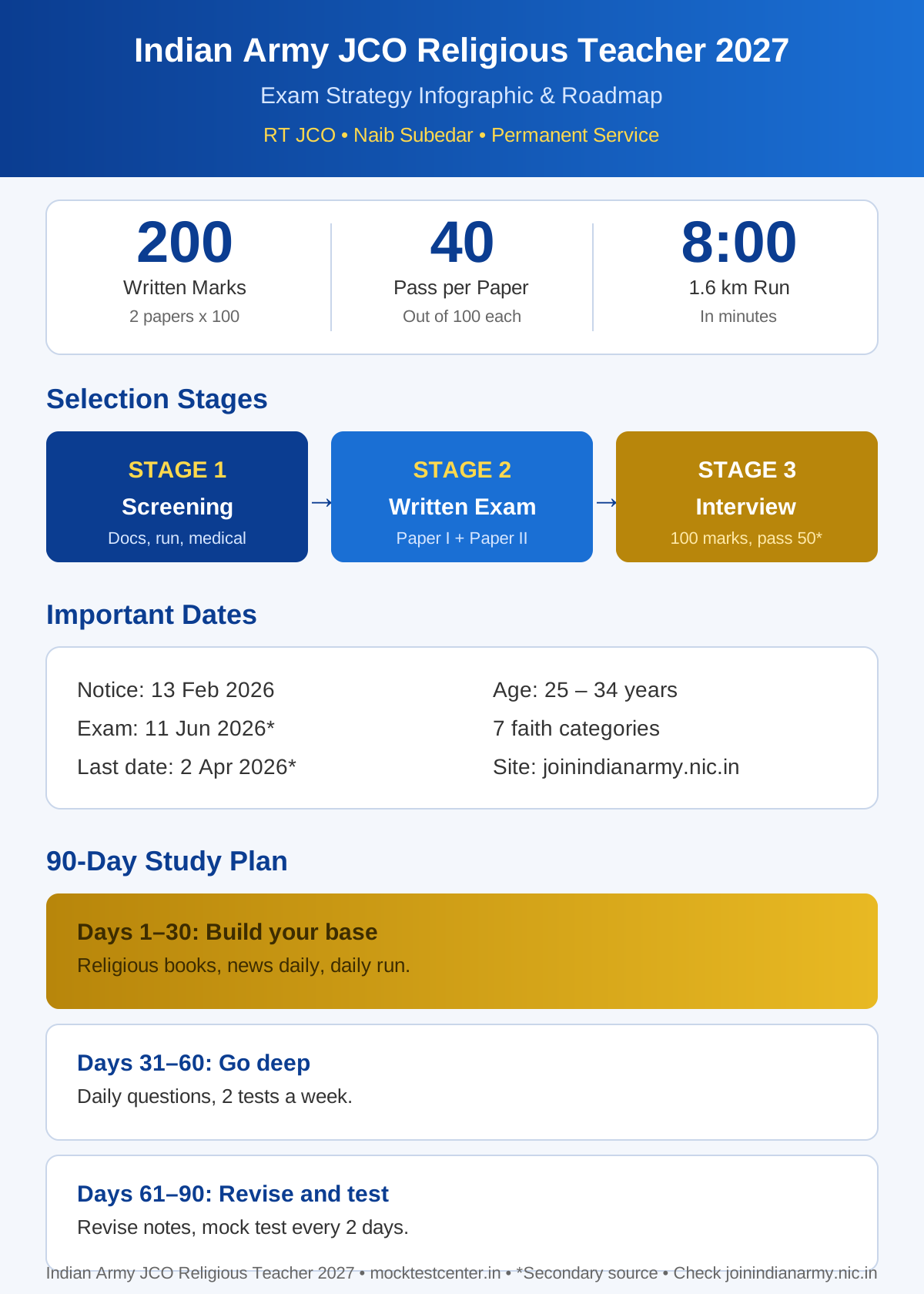
Exam pattern means how the exam is set. Selection has three parts: screening, written examination, and interview. Screening has document checking, a physical fitness test, and a medical test. Only men who pass screening go to the written exam.
The written exam has two papers. Paper I is General Awareness, common to all faiths, with 50 objective questions for 100 marks. Paper II is on the religious subject of your own faith, with 50 questions for 100 marks. Each question carries 2 marks, and each wrong answer cuts 0.5 marks. You must score at least 40 marks in each paper. Paper I is only for qualifying, and its marks are not counted in the merit list.
Men who pass the written exam go to the interview, which is for 100 marks, and you must score at least 50 marks to pass, as per secondary sources. The physical fitness test needs a 1.6 km run in 8 minutes, with extra time in hilly areas.
| Stage | What happens | Marks / time |
|---|---|---|
| Stage 1: Screening | Documents, physical test, medical test | 1.6 km run in 8 minutes |
| Stage 2: Paper I | General Awareness, 50 questions | 100 marks, pass 40 (qualifying only) |
| Stage 3: Paper II | Religious subject of your faith, 50 questions | 100 marks, pass 40 |
| Stage 4: Interview | Personal interview | 100 marks, pass 50* |
*Interview pass mark of 50 is from secondary sources. The written exam pattern is from the official notification and secondary sources that agree with it.
Syllabus
Syllabus means the list of topics you must study. Paper I, General Awareness, covers India and the world, history, geography, sports, awards, books and authors, the Constitution of India, current news, and the Indian Armed Forces.
Paper II is on your own faith. For Pandit, it covers Sanskrit, Hindu scriptures, rituals, and Karam Kand. For Granthi, it covers the Guru Granth Sahib, Sikh history, and Punjabi. For Maulvi, it covers the Quran, Hadith, Arabic or Urdu, and Islamic history. For Padre, it covers the Bible. For Bodh Monk, it covers the teachings of the Buddha.
Your religious books are your best base for Paper II. Study them in small parts, write short notes, and revise them every week.
- Paper I: General Awareness — India, world, history, geography, sports, Constitution, current news
- Paper II (Pandit): Sanskrit, Hindu scriptures, rituals, Karam Kand
- Paper II (Granthi): Guru Granth Sahib, Sikh history, Punjabi
- Paper II (Maulvi): Quran, Hadith, Arabic or Urdu, Islamic history
- Paper II (Padre / Bodh Monk): Bible and Christian teaching, or Buddhist texts
Important dates
The dates below are for the 2027 recruiting year. The notification came on 13 February 2026, and registration opened the same day. One source says the last date was 2 April 2026, and another says it was extended to 10 April 2026. Both are from secondary sources, so this page gives both.
The written exam was fixed for 11 June 2026, as per secondary sources. The admit card, interview, and final result dates are fixed after the exam. The fee is reported as 250 rupees plus GST, as per secondary sources, and is not verified from the official notification. For the next cycle, no dates have been announced yet. Check joinindianarmy.nic.in every week.
| Event | Date |
|---|---|
| Notification | 13 February 2026 |
| Online registration opens | 13 February 2026 |
| Last date to apply | 2 April 2026 (one source says 10 April 2026, extended) |
| Written exam | 11 June 2026 (secondary source) |
| Interview | Date awaited (tentative) |
| Final result | Date awaited (tentative) |
| Next cycle notice | Date awaited (tentative) |
Cut-off
Cut-off means the lowest marks that can pass a stage. The pass marks are clear: 40 out of 100 in Paper I, 40 out of 100 in Paper II, and 50 out of 100 in the interview, as per secondary sources. Paper I is only for qualifying, so its marks do not count in the merit list.
We give no final cut-off number here, because none is verified for this exam. The final cut-off changes every year with the number of men who apply, the posts in each faith, and how hard the paper is.
Do not aim for just 40 marks in Paper II. Aim for 70 or more out of 100, and prepare well for the interview. Give more time to your religious subject, because it counts in the merit list.
Best books
Do not buy ten books for one topic. One good book is enough. Read it two times.
For Paper I, use one good book on general knowledge and current affairs, and read a good newspaper every day. For Paper II, use your own religious books first, because the exam rests on them.
No exact book title is given here, because no book is named in the official notification. Ask your teacher or a senior who passed the RT JCO exam which book helped them.
- Your religious books (Sanskrit, Guru Granth Sahib, Quran, Bible, Buddhist texts)
- One good book on general knowledge and current affairs
- A good newspaper every day for current news
- Old papers of the RT JCO exam for practice
90-day study plan
Days 1 to 30: Build your base. Read your religious books again and make short notes. Read the news for 30 minutes each day. Start running every morning and build up to 1.6 km in 8 minutes. Give one small test each week.
Days 31 to 60: Go deep. Read each topic in more depth and solve questions from Paper I and Paper II every day. Practice the physical test every morning. Give two mock tests each week and write your mistakes in a diary.
Days 61 to 90: Revise and test. Read your notes again and again. Do not start any new book now. Give a full mock test every two days. Practice speaking about your faith, because the interview will test it.
How to use mock tests
Mock tests are practice tests that look like the real exam. They show your weak topics, teach you time control, make you brave, and show your true score.
Take mock tests on mocktestcenter.in. Start with one test each week, then two each week, and in the last month, one every two days. Always check your answers after a test and write the right answers in your notes.
Keep a small diary for your study. Write the date, the topics you read, and the marks you got in each mock test. Give your weak topics one extra hour each day.
Solve old question papers if you can get them. Old papers show the style of the questions and the topics that come again and again. Time yourself and check every wrong answer.
If you are getting ready for more than one Army exam, you can also look at Indian Army Agniveer Women Military Police 2027, Indian Army Soldier Nursing Assistant 2027, Indian Army Sepoy Pharma 2027, Indian Army JCO Catering 2027, 72nd BPSC Prelims 2027, BPSC TRE 4.0 Teacher Recruitment 2027, BPSC Assistant Engineer 2027 and 33rd Bihar Judicial Services 2027. Each page has its own mock tests, study plan and simple notes. You can also see BPSC Assistant Section Officer 2027, BPSC Auditor 2027, BPSC District Statistical Officer 2027 and BPSC Motor Vehicle Inspector 2027 on this site. The official site for all Army news is joinindianarmy.nic.in.
A last word
The JCO Religious Teacher entry is a noble chance for men of faith to serve soldiers in uniform as Naib Subedar. It needs a degree, a religious qualification, a fit body, and a true heart for service. The 2027 cycle is over, but the next cycle will come soon.
Start today. Do not wait for the new notice. Build your base in your religious books and general awareness, run every morning, and give mock tests. When the notice comes, read it on joinindianarmy.nic.in and apply.