About Indian Army Havildar Surveyor Automated Cartographer 2027 Exam Series
📖 Table of Contents
Indian Army Havildar Surveyor Automated Cartographer 2027
What is this exam
The Indian Army picks Havildar (Surveyor Automated Cartographer), also called Havildar SAC, for the Corps of Engineers. A Havildar is a senior soldier rank, above Naik and below Naib Subedar. You join straight as a Havildar, not as a new recruit.
A Surveyor Automated Cartographer makes digital maps for the Army. The work is about digital cartography and GIS, which means Geographic Information System, a computer system that stores and shows map data. The Army uses GIS maps to plan and take decisions. If you love maths, maps and computers, this post fits you.
This is a full service entry, not the four-year Agniveer entry. It is a technical post for maths and engineering graduates, with a long Army career, pay, a home and medical care. Only Indian citizens can apply. One source says both male and female candidates can apply, while other sources say male only. That point is not settled, so check the latest notice.
Who can apply / Eligibility
Eligibility means who is fit to apply. The rules here are from the official notice for 2025-26 and from secondary sources for 2026-27. No official 2027 notice is out yet, so a new notice may change them.
First, the age. One secondary source says the age for the 2026-27 cycle is 20 to 27 years as on 01 July 2027. But the last official notice, for 2025-26, says civilians must be 20 to 25 years as on 01 October 2025, and in-service candidates must be below 28 years. The two do not match. This page gives 20 to 27 years as the reported age, but check the official notice, because the age rule is not verified from an official 2027 notice.
Second, the education. You must have a BA or BSc degree with Mathematics, and Class 12 (10+2) with Physics, Chemistry and Mathematics as main subjects, with at least 50 percent marks in each of them. OR a BE or BTech degree in Civil, Electronic, Electrical, Instrumentation, Mechanical, Computer Technology or Computer Science, and Class 12 PCM with at least 50 percent in each subject. The 50 percent rule applies to each subject, not just the total. The rules are the same for civilians and in-service candidates. No work experience is needed.
Third, you must be an Indian citizen. Keep your degree, mark sheets, Class 10 and 12 papers, photo and ID proof ready. Do not pay any person who says he can get you a seat. The Army says selection is fair and on merit only.
- Indian citizen
- Age 20 to 27 years as on 01 July 2027, as reported (last official notice said 20 to 25 years)
- BA/BSc with Mathematics + Class 12 PCM, 50% marks in each subject
- OR BE/BTech (Civil / Electronic / Electrical / Instrumentation / Mechanical / Computer Technology / Computer Science) + Class 12 PCM, 50% in each subject
- No work experience needed
Posts and vacancies
Vacancy means the number of empty posts. No vacancy number has been found for the 2027 cycle. One old source gives 20 posts for a cycle years ago, but that number does not apply to 2027. So this page gives no vacancy number. Do not trust a site that prints a fixed number.
The Army takes only a small number of Havildar SAC in each cycle, because it is a specialist post. The final merit list will decide who gets in, so your marks matter more than the number of seats. A top score in Mathematics is the best way to stand out.
Exam pattern
Selection has two parts: a Computer Based Examination, also called the online CEE, and a rally with physical tests, measurement, an adaptability test and a medical check.
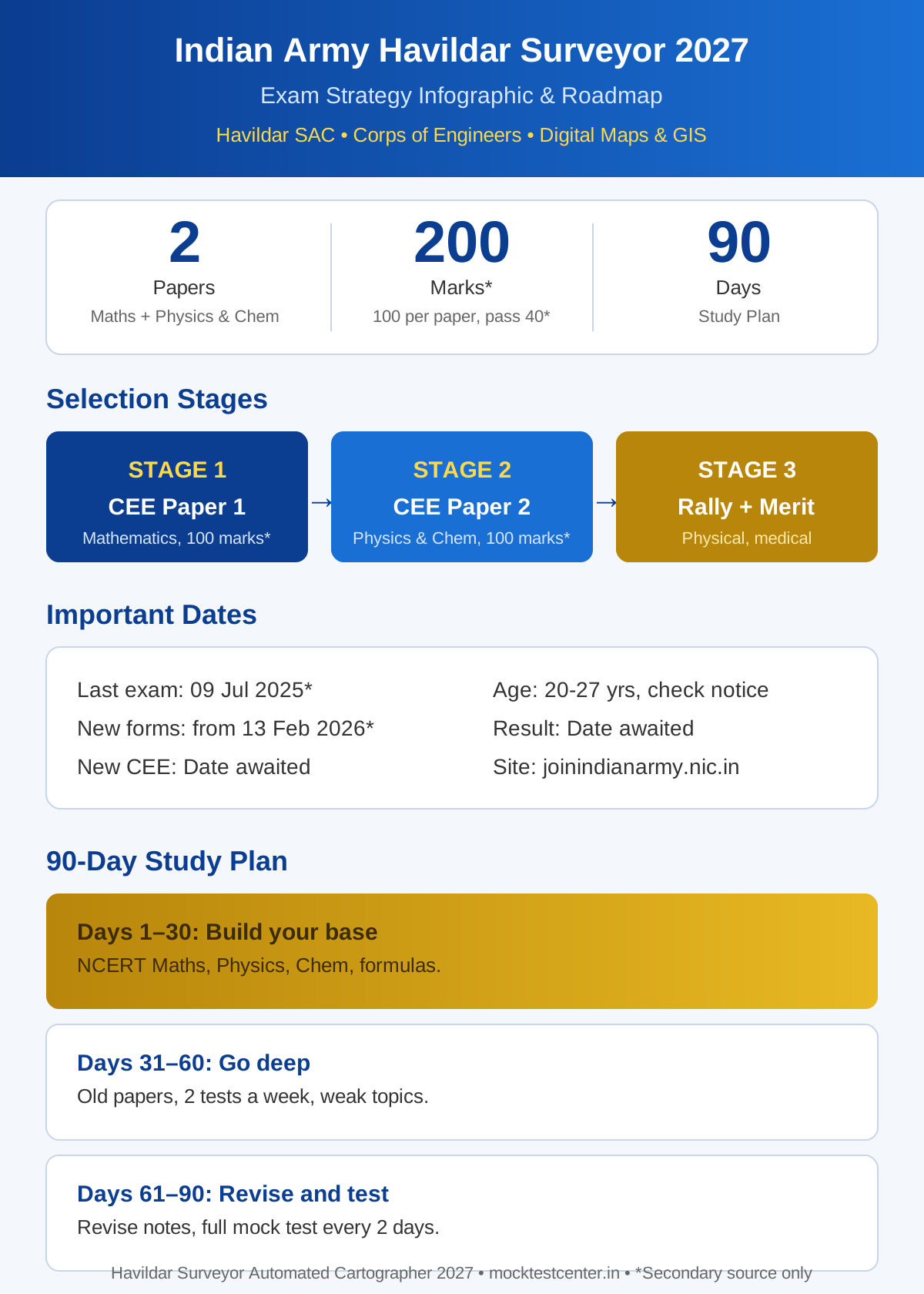
The written exam has two papers, as per secondary sources. Paper 1 is Mathematics, with 50 questions. Paper 2 is Physics and Chemistry, with 50 questions. Each paper is of 100 marks, and you must score at least 40 in each paper to go ahead. That means you must pass both papers on their own. The time for each paper and the negative marking rule are not verified, so this page gives no number for them. Check your admit card for the final word.
After the written exam, shortlisted candidates go to a rally. The rally has a physical fitness test, a measurement test, an adaptability test and a medical check. The final merit list comes after all stages. Its date is awaited.
| Stage | What happens | Marks / time |
|---|---|---|
| Stage 1: CEE Paper 1 | Mathematics | 50 questions, 100 marks; pass mark 40* |
| Stage 1: CEE Paper 2 | Physics and Chemistry | 50 questions, 100 marks; pass mark 40* |
| Stage 2: Rally | Physical test, measurement, adaptability test, medical | Must pass |
| Stage 3: Final merit list | Final list from all stages | Date awaited |
*Paper-wise marks and pass marks are from secondary sources only.
Syllabus
Syllabus means the list of topics you must study. The official syllabus is in the notice on joinindianarmy.nic.in. The broad topics below are from secondary sources, in simple words only.
Paper 1, Mathematics, covers Algebra, Vector Algebra and Trigonometry, Matrices and Determinants, Analytical and 3D Geometry, Calculus, Probability and Statistics, Number Systems and Complex Numbers, arithmetic, Mensuration, Area, Volume and Surface Area, Binomial Theorem, Sequence and Series, and Permutation and Combination. This is Class 11 and 12 level maths, plus some degree level topics. Give maths the most time.
Paper 2, Physics and Chemistry, covers Class 11 and 12 level topics: mechanics, heat, light, sound, current, magnets, atoms, and physical, organic and inorganic chemistry. Use your Class 11 and 12 NCERT books first, because most questions come from that level. Also study basic map and GIS terms.
- Paper 1 (Maths): algebra, trigonometry, matrices, geometry, calculus, probability, number systems
- Paper 2 (Physics): mechanics, heat, light, sound, current, magnets, atoms
- Paper 2 (Chemistry): physical, organic and inorganic chemistry
- Maps and GIS: basic terms of digital cartography
Important dates
The dates below are from the last cycle and secondary sources. For 2025-26, registration ran from 12 March 2025 to 25 April 2025 (extended), and the exam was held on 09 July 2025, as reported. For 2026-27, registration opened with the other Army entries on 13 February 2026, and the online exams were planned from 01 June to 15 June 2026, as reported. No SAC exam date for the new cycle has been found. Rally and result dates are awaited. Check joinindianarmy.nic.in every week.
| Event | Date |
|---|---|
| Last registration (2025-26) | 12 March 2025 to 25 April 2025 (extended) |
| Last cycle exam (2025-26) | 09 July 2025, as reported |
| New registration opens | 13 February 2026, as reported |
| New CEE | Date awaited (tentative) |
| Recruitment rally | Date awaited (tentative) |
| Final result | Date awaited (tentative) |
| New notice for 2027 | Date awaited (tentative) |
Cut-off
Cut-off means the lowest marks that can pass a stage. Here the first line is clear, as per secondary sources: you must score at least 40 out of 100 in Paper 1 and in Paper 2. If you fail even one paper, you are out. Note that 40 is a pass mark, not a cut-off, and it is from secondary sources only.
But the final merit cut-off is not published, so we give no number here. It will change with the seats, the students, and how hard the paper is. With very few seats, the cut-off may be high, so aim for 60 out of 100 in each paper. Give Mathematics the most time.
Best books
Do not buy ten books for one topic. One good book, read two times, is enough. Use your Class 11 and 12 NCERT books first, because most questions come from that level. For degree level maths, use your BA, BSc or BE/BTech books. For GIS and maps, use your course notes.
Read a good newspaper every day. No exact book title is given here. Ask a teacher or a senior which book helped them. Solve old papers if you can get them. Practice maths sums daily, because speed comes only from practice.
- Class 11 and 12 NCERT books for Maths, Physics and Chemistry
- Your degree books for higher maths (BA/BSc/BE/BTech)
- Your course notes on maps and GIS basics
- A good newspaper every day
90-day study plan
Days 1 to 30: Build your base. Read your NCERT books again and make short notes. Learn the key formulas by heart and practice sums daily. Start running in the morning. Give one small test each week.
Days 31 to 60: Go deep. Read each topic in more depth and solve old papers. Practice Paper 1 and Paper 2 in one sitting, within the time limit. Give two mock tests each week and write your mistakes in a diary. Give weak chapters one extra hour each day.
Days 61 to 90: Revise and test. Read your notes and formulas again and again. Do not start any new book now. Give a full mock test every two days, sitting for the full time like a real exam. Sleep well. Keep your documents ready for the rally.
How to use mock tests
Mock tests look like the real exam. They show your weak topics, teach you time control, and show your true score.
Take mock tests on mocktestcenter.in. Start with one test each week, then two each week, and in the last month, one every two days. Always check your answers after a test. Sit in a quiet room, keep your phone away, and use a clock. Practice Paper 1 and Paper 2 back to back, in the same order as the real exam.
Keep a small diary of the topics you read and the marks you got in each mock test. After two weeks, you will see which topics are weak. Give those topics one extra hour each day.
Make short notes with only the key point or the formula in one or two lines. Read them again and again in the last month. Solve old papers if you can get them. Time yourself while you solve them.
If you are getting ready for more than one Indian Army entry, you can also look at Indian Army Havildar Education 2027 and Indian Army Sports Quota 2027 on this site. Each page has its own mock tests and study plan. You can also see 72nd BPSC Prelims 2027, BPSC TRE 4.0 Teacher Recruitment 2027, BPSC Assistant Engineer 2027, 33rd Bihar Judicial Services 2027, BPSC Assistant Section Officer 2027, BPSC Auditor 2027, BPSC District Statistical Officer 2027 and BPSC Motor Vehicle Inspector 2027 on this site. The official site for all Indian Army news is joinindianarmy.nic.in.
A last word
Havildar (Surveyor Automated Cartographer) is a rare chance for a maths or engineering graduate to join the Indian Army straight as a Havildar, and work with digital maps and GIS in the Corps of Engineers. The education rule is clear: a BA or BSc with Mathematics, or a BE or BTech in the listed branches, with Class 12 PCM at 50 percent in each subject.
Start today. Do not wait for the new notice. Build your base in maths, physics and chemistry, and practice sums every day. When the notice comes, read it on joinindianarmy.nic.in and apply at once. Check the age rule in the notice with care, because the reported age and the last official age differ.