
About Goa Excise Inspector 2027 Exam Series
📖 Table of Contents
- Goa Excise Inspector 2027 at a glance
- The 2021 cycle, and why this guide still uses it
- What an Inspector of Excise actually does all day
- Who can apply
- The four posts in the 2021 advertisement
- Pay, and what Level 5 means in hand
- How selection works
- The written paper: how to prepare without an official syllabus
- The height test, and the two traps in the age line
- A 90 day plan that fits a working graduate
- Mistakes that cost candidates a cycle
- How this guide was put together
- Sources
Goa Excise Inspector 2027: Complete Exam Guide
Thirteen posts. That is the whole of the last Inspector of Excise recruitment in Goa. The Office of the Commissioner of Excise advertised 13 Inspector posts in November 2021, inside a 46 post advertisement that also covered Sub Inspectors, a Junior Stenographer and Assistant Excise Guards.
This Goa Excise Inspector 2027 guide works from that 2021 cycle, because no fresh Excise Inspector notification has come out since. The Goa Staff Selection Commission advertised 219 Group C posts in December 2025 and 32 more in October 2026, and neither list carries a single Excise post. A candidate who waits for a new advertisement before starting will start late.
The post itself is small and specific. An Inspector of Excise in Goa checks distilleries and breweries, and licensed bars, measures stocks against registers, collects duty on liquor that leaves a bonded warehouse, and leads surprise checks on illegal sale and transport. It is field work in uniform, with a beat and a register, with a lock and key. Graduates who like desk work should look elsewhere.
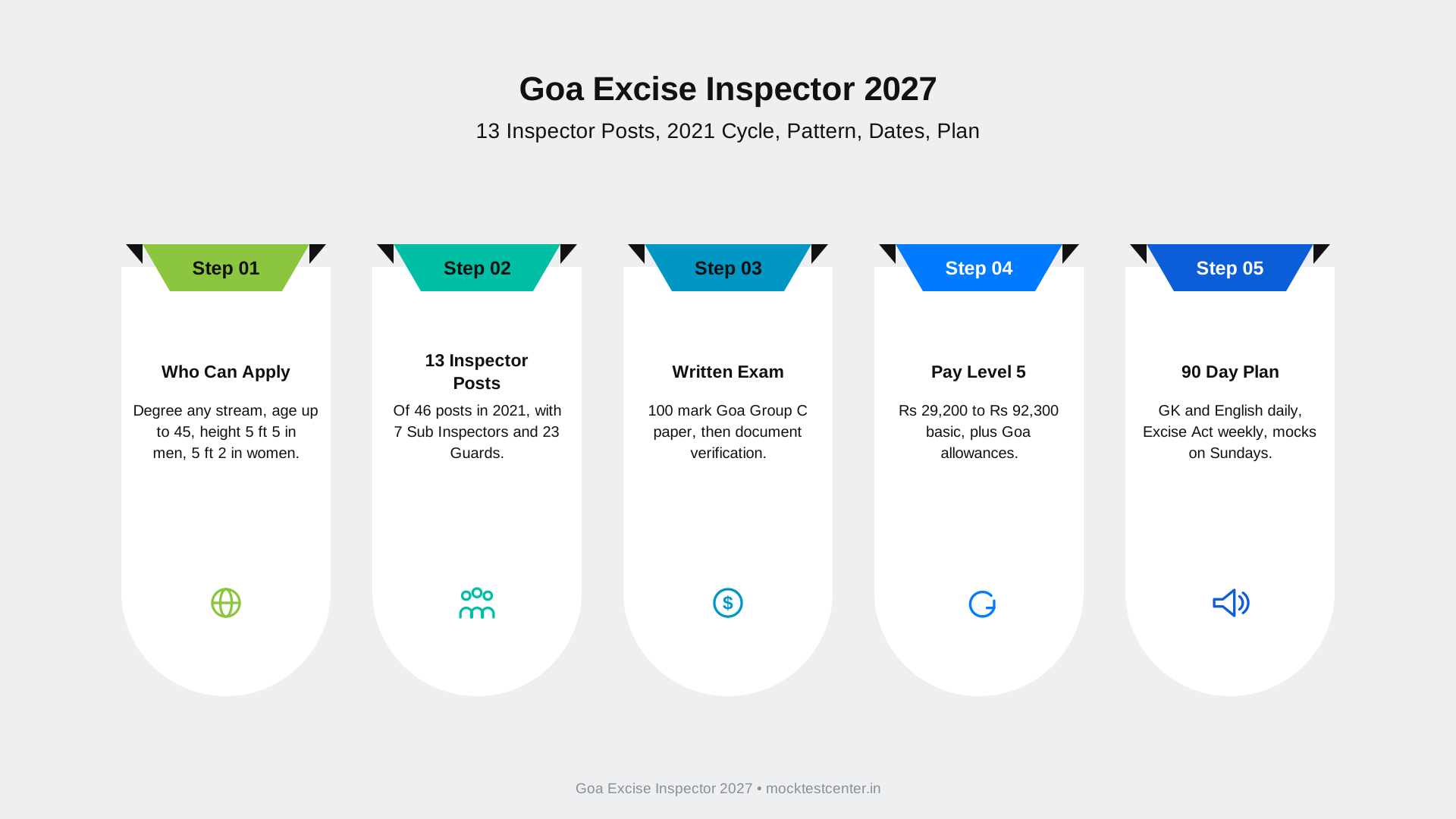
Three numbers decide whether a candidate can even apply. The first is the degree. The Inspector post needs a three year degree from a recognised university. The second is height. A male candidate needs 5 feet 5 inches and a female candidate needs 5 feet 2 inches. The third is age. The upper limit in the 2021 advertisement was 45 years, with relaxations for government servants and reserved categories.
Pay sits at Level 5 of the pay matrix, which puts the post above most Group C posts in the state. Selection runs through a written examination and document verification, and the 2021 advertisement charged no application fee. The rest of this guide works through each of those facts in turn, with the exact figures from the 2021 advertisement and the gaps in the public record marked clearly where they are.
Goa Excise Inspector 2027 at a glance
| Detail | Goa Excise Inspector 2027 |
|---|---|
| Conducting body | Office of the Commissioner of Excise, Goa |
| Post | Inspector of Excise, Group C |
| Latest verified cycle | 2021, 46 posts across four designations |
| Inspector posts in 2021 | 13 |
| Application window in 2021 | 25 November to 10 December 2021, online |
| Education | Three year degree from a recognised university |
| Height | Male 5 feet 5 inches, female 5 feet 2 inches |
| Age | Upper limit 45 years in 2021, relaxations apply |
| Pay | Pay Matrix Level 5 |
| Application fee in 2021 | None, as reported by trackers |
| Selection | Written examination and document verification |
| 2025 and 2026 cycles | None found for Excise Inspector |
| Official website | excise.goa.gov.in |
The 2021 cycle, and why this guide still uses it
The 2021 advertisement opened online applications on 25 November 2021 and closed them on 10 December 2021. Candidates applied through the Government of Goa portal, and the advertisement listed 46 posts in all. Thirteen went to Inspector of Excise, seven to Sub Inspector of Excise, three to Junior Stenographer and 23 to Assistant Excise Guard. Those four numbers add to 46, and every tracker that reproduces the advertisement prints the same four numbers.
Five years have passed since that window closed, and the department has advertised no Inspector of Excise posts since. The check behind that claim is direct. The Goa Staff Selection Commission now handles most Group C recruitment in the state, and its advertisement list for 2025 and 2026 is public. Advertisement No. 3 of Year 2025, dated 5 December 2025, lists 219 posts across 26 designations. The list runs from Talathi and Investigator to Laboratory Assistant and Village Panchayat Secretary. The list carries no Excise post of any kind. Advertisement No. 4 of Year 2026, dated 1 October 2026, lists 32 posts only, five Food Safety Officers and 27 Veterinary Assistants. Again, no Excise post appears.
The Goa Public Service Commission advertisements for 2025 and 2026 cover Group A and Group B posts such as Assistant Professors and department officers, and none of them covers an Inspector of Excise. The Excise Department site itself, excise.goa.gov.in, carries department information and no open recruitment notice for Inspectors as of November 2026.
That silence shapes how a candidate should read this guide. The 2021 advertisement is the latest real document for this post, so the eligibility and height and age and pay figures in this guide come from it. The next advertisement will most likely follow the same shape, because Goa Group C recruitment rules change slowly and the 2021 advertisement already follows the standard state pattern. But the next advertisement can still change the post count, the age limit or the selection stages, and the final word always belongs to the new advertisement when it appears.
The gap also changes the competition. A post that last opened five years ago builds a queue. Graduates who finished their degrees in 2022 or 2023 or 2024 or 2025 have all waited for the same 13 post advertisement to return, and the next window will draw every one of them at once. A candidate who treats the next notification as the starting gun will face a crowd that started months earlier. The written paper rewards the candidate who prepared on the old pattern while the advertisement was still silent.
One more point belongs here. Some tracker pages still show the 2021 advertisement with a 2026 date stamp, because the page itself was updated or re indexed in 2026. The advertisement is from 2021 all the same, and its last date of 10 December 2021 has long passed. Any page that invites applications for Goa Excise Inspector posts right now, without a new advertisement number on gssc.goa.gov.in or goa.gov.in, deserves a check against the official list before a candidate pays a fee or shares documents.
What an Inspector of Excise actually does all day
Goa runs on liquor revenue and liquor control in equal measure, and the Excise Inspector sits where those two meet. The Goa Excise Duty Act of 1964 gives the Commissioner of Excise the power to appoint Inspectors and Sub Inspectors, and it gives those officers the power to enter and inspect places of manufacture and sale, to seize excisable articles, to search with or without warrant in the conditions the Act sets, and to investigate offences under the Act. The Inspector is the officer who turns those powers into daily work.
A large part of that work happens inside a distillery, a brewery or a winery. The department posts an Excise official permanently at each manufacturing unit, and an Inspector at a distillery watches every stage of production. Fermentation comes first, then distillation, then blending, then bottling. Each stage passes under the Inspector's eye, and the Inspector checks that the unit works inside its licensed capacity and its licence terms. Raw materials get the same attention. Molasses and grain and malt arrive in measured quantities, as does extra neutral alcohol, and the Inspector checks how raw material is received and stored and used, so that no stock moves sideways into unrecorded production.
Registers are the spine of the job. The Inspector maintains and verifies statutory registers for production and stock. Separate entries track dispatches and wastage and returns, and the Inspector checks their accuracy before they go up to the Superintendent of Excise. Bottling gets checked against the approved label registration, and every bottle needs a valid excise adhesive label or hologram before it leaves the unit. Duty follows the same paper trail. The Inspector assesses excise duty from production and dispatch records and makes sure the licensee pays it on time. Dispatches move only on valid permits and challans, and the Inspector verifies each one, so that no liquor leaves without a record.
Surprise checks fill the rest of the week. The Inspector inspects raw material stocks, stocks of finished goods, the blending vats, the sealed areas, checks the excise locks and seals, and reports any irregularity to the Superintendent. Reports on production and duty and stock go up the chain from the Inspector's desk daily, weekly or monthly. Constant watch against illegal manufacture and adulteration and diversion is part of the written duty list, and the Inspector reports any such incident at once.
The taluka beat is the other half of the post. Taluka Excise Inspectors monitor licensed premises in their area. The beat covers bars and retail shops and wholesale godowns, and the Inspectors keep watch over illegal sale and transport. The department runs an Enforcement cell in North Goa and another in South Goa, and each cell carries out regular surprise inspections across the state to curb illegal liquor activity. Border check posts add a third beat. At those posts, a team headed by a Sub Inspector of Excise monitors vehicles coming in and going out, looking for non duty paid liquor and smuggled stock.
The Assembly record shows how live this work stays. In July 2025, the Excise Department answered questions in the Goa Legislative Assembly about cases registered between 2020 and 2025 for illegal production and sale, transport of non duty paid liquor, smuggling across state borders and bars running without valid licences. The same answer recorded departmental inquiries against two Inspectors over allegations of collusion with illegal liquor operators, with action to follow the inquiry reports. A candidate who joins this service joins a department where the Assembly watches the work and where a posting at a distillery or a check post carries real responsibility.
That responsibility is also the reason the post needs a height standard and field fitness. An Inspector climbs into godowns, walks distillery floors, stands at check posts through the night and joins raids with the Enforcement cell. The job is not a desk posting with occasional field visits. The field is the posting.
Who can apply
Eligibility for Inspector of Excise rests on three conditions, and all three need checking before a candidate fills the form. The first is education. The 2021 advertisement asks for a three year degree from a recognised university, or an equivalent qualification approved by the University Grants Commission or the All India Council for Technical Education. The degree can come from any stream. Graduates in arts or commerce or science or a professional stream all qualify on the education condition, and the advertisement names no preferred subject.
The second condition is height, and it is a hard gate. A male candidate needs a minimum height of 5 feet 5 inches, and a female candidate needs 5 feet 2 inches. The measurement happens at document verification, and a candidate who falls short by half an inch goes out at that stage, whatever the written paper score. Candidates near the line should measure themselves with shoes off, before they spend weeks on preparation.
The third condition is age. The 2021 advertisement sets the upper age limit at 45 years. Government servants get a relaxation of five years. Candidates from Scheduled Castes and Scheduled Tribes get five years, and candidates from Other Backward Classes get three years. The age counts as on the last date of application in the advertisement, so a candidate who turns 46 a week after the last date still qualifies, and a candidate who turned 46 a week before it does not.
One tracker page prints the age line as "above 45 years", which reads as if candidates must be older than 45. That line is a garble. The 2021 advertisement and every other tracker reproduction set the limit as "not exceeding 45 years", and the Goa Group C pattern for the same year, such as the Civil Supplies advertisement of March 2021, uses the same "not exceeding 45 years" wording. This guide uses 45 as the upper limit.
Two conditions that candidates often ask about do not appear in the tracker reproduction of the 2021 advertisement for this post. The first is knowledge of Konkani. Most Goa Group C posts carry a Konkani condition, and the Civil Supplies Inspector advertisement of 2021 lists it as essential. The excise advertisement reproduction lists degree and height only for the Inspector post, with no language condition shown. Candidates should read the new advertisement for a Konkani line before they apply, because the recruiting body can add it, and a Konkani speaking candidate holds an edge in taluka work in any case.
The second is residence. Goa Group C advertisements commonly ask for a 15 year residence certificate, and the Fire Services advertisement of the same year asks for it in terms. The excise reproduction does not show a residence line for the Inspector post. The same advice applies. Read the new advertisement, and keep a residence certificate ready if the family has lived in Goa for 15 years, because that paper takes time to obtain and the application window in 2021 lasted only 16 days.
The four posts in the 2021 advertisement
The Inspector post never travels alone. The 2021 advertisement grouped it with three other posts, and a candidate who misses the Inspector height standard or the degree condition may still qualify for one of the others. The table below gives the full picture from the advertisement.
| Post | Posts in 2021 | Education | Pay level |
|---|---|---|---|
| Inspector of Excise | 13 | Three year degree from a recognised university | Level 5 |
| Sub Inspector of Excise | 7 | Higher Secondary Certificate | Level 4 |
| Junior Stenographer | 3 | Higher Secondary Certificate or diploma, shorthand 100 words per minute, typing 35 words per minute, three month computer course | Level 4 |
| Assistant Excise Guard | 23 | Middle School pass | Level 1 |
Sub Inspector of Excise is the natural second target for a graduate who misses the Inspector height standard, because the Sub Inspector post carries the same height standard of 5 feet 5 inches for men and 5 feet 2 inches for women, so the height gate is identical. What changes is education. The Sub Inspector post needs only a Higher Secondary Certificate, and it pays at Level 4, one level below the Inspector post. Sub Inspectors head the teams at border check posts, and they work the same taluka beats as Inspectors, under an Inspector or Superintendent.
Junior Stenographer is a different kind of post. It needs a Higher Secondary Certificate or a technical diploma, shorthand at 100 words per minute, typing at 35 words per minute and a three month computer course. Three posts only were advertised, so the contest for those three seats runs far tighter than the contest for the 13 Inspector seats, and shorthand speed decides it more than general knowledge does.
Assistant Excise Guard is the largest group in the advertisement, with 23 posts, and it needs only a Middle School pass. The height standard is the same 5 feet 5 inches for men and 5 feet 2 inches for women, and male candidates also face a chest measurement of 31 to 33 inches. It pays at Level 1, the entry level of the matrix. Guards staff check posts, accompany Inspectors on raids and guard seized stock and godowns. A candidate who holds a degree and clears the Inspector paper should not apply for a Guard post in the same cycle, because the department fills each post from its own list, and a Guard appointment closes the door to the Inspector list for that cycle.
Pay, and what Level 5 means in hand
Inspector of Excise pays at Pay Matrix Level 5 under the Seventh Pay Commission. The Level 5 scale runs from Rs 29,200 to Rs 92,300 a month as basic pay, and the starting basic pay for a fresh Inspector sits at Rs 29,200. Dearness allowance, house rent allowance and transport allowance sit on top of basic pay at the rates the Goa government notifies from time to time, so the monthly in hand figure moves with those rates and with the posting station.
Level 5 is worth comparing with the other posts in the same advertisement. Sub Inspector and Junior Stenographer sit at Level 4, and Assistant Excise Guard sits at Level 1. The Inspector post therefore starts higher and climbs higher than every other post in its own advertisement, and it carries a gazetted officer's field charge in the taluka without gazetted rank. For a graduate, it is the best paid Group C post the Excise Department offers, and the gap between Level 5 and Level 4 is the reason the Inspector paper draws the most graduates.
Promotion runs upward through the department. An Inspector can rise to Superintendent of Excise and beyond, through departmental promotion and seniority, and the field experience gathered at distilleries and check posts counts toward those promotions. The department also runs its Enforcement cells from Inspectors, so an Inspector who builds a record on raids and seizures gets noticed faster than one who stays inside the office. None of that appears in the advertisement, because promotion rules sit in the service rules, and the advertisement only lists the entry post. A candidate should still know the ladder exists before choosing this post over a Level 4 post elsewhere.
One caution belongs with the pay figure. The 2021 advertisement lists the pay as "Level 5" and gives no amount, and the Rs 29,200 to Rs 92,300 range comes from the Seventh Pay Commission matrix for Level 5, which the Goa government follows. If the next advertisement revises the level or the state revises the matrix, the figure moves with it. The level is the fixed fact. The amount follows the matrix in force on the date of appointment.
How selection works
Selection for the 2021 cycle ran on a written examination followed by document verification. The trackers agree on those two stages, and they disagree on whether an interview followed. One tracker lists the process as written examination and document verification only. Another lists it as written examination and interview. The advertisement reproduction that both trackers quote does not settle the question in the text available, because the selection paragraph in the reproduction is short and the interview line is the point on which the two trackers part.
This guide records the disagreement rather than picking a side. The safer reading is that the written paper decides the merit list and document verification confirms eligibility and height and age, because that is how Goa Group C recruitment ran for comparable posts in 2021. The Civil Supplies Inspector advertisement of March 2021, for instance, selected on a written examination of 100 marks with no interview stage. A candidate should still prepare for a short interview, because a viva of a few minutes on the Excise Act and current affairs costs little to prepare for and protects against the version of the process that includes one.
The written paper itself is the part of the process the public record leaves thinnest. The 2021 advertisement reproduction gives no syllabus, no subject list, no mark split and no duration for the Inspector paper. No tracker page prints an official Excise Inspector syllabus for Goa, and the Excise Department site carries no syllabus document for the post. That is a gap, and this guide marks it as one instead of filling it with invented figures.
What the record does show is the shape of Goa Group C written papers of the same period. The Civil Supplies Inspector paper of 2021 was a written examination of 100 marks. The Fire Fighter paper of 2021 was a written examination of 100 marks in two hours. Goa Group C papers of that period test four subjects in objective form: General Knowledge, General English, Mathematics, Reasoning, with 100 questions for 100 marks. A candidate who prepares on that shape, and who adds the Goa Excise Duty Act and Goa general knowledge to it, covers the most likely paper. The section below turns that shape into a study plan, and it labels every part of it as preparation advice, because the notification itself carries no syllabus.
Document verification comes after the written paper, and it is a real stage rather than a formality. The candidate produces the degree certificate and birth proof, the caste certificate where claimed, and the online application printout, and stands for height measurement. A degree certificate that shows a pass date after the last date of application can fail verification, and a caste certificate in the wrong format can do the same. Candidates should keep originals and two sets of self attested copies ready from the day they apply, because the verification call can come with short notice.
The 2021 cycle charged no application fee, according to the tracker reproduction. That is unusual enough to double check. Most Goa Staff Selection Commission advertisements charge Rs 400 for Level 4 and above posts from general candidates, with lower fees for reserved categories. The 2021 Excise advertisement ran through the department and the state portal rather than the Commission, and its reproduction lists the fee as none. The next cycle may run through the Commission instead, and a Commission run advertisement will carry a fee. Candidates should check the fee line in the new advertisement and pay it online before the last date, because an unpaid form is an unsubmitted form.
The written paper: how to prepare without an official syllabus
The absence of an official syllabus is the hardest fact in this guide, and it is also the fact that separates candidates who prepare from candidates who wait. A candidate who waits for a syllabus will wait until the advertisement, and the advertisement gives 16 days in the last cycle. A candidate who prepares on the Goa Group C shape will walk into the hall with the subjects already covered, and will only need the last two weeks to adjust to the real syllabus if it differs.
General Knowledge carries the most weight in a Goa Group C paper, and Goa knowledge inside it carries the most marks per hour of study. The candidate should know the two districts of North Goa and South Goa, the 40 member Legislative Assembly, the capital Panaji, the official language Konkani, and the state symbols. The state bird is the flame throated bulbul, the state animal is the gaur, the state tree is the matti, and the state fruit is the cashew. The state emblem shows a Vriksha Deep lamp ringed by coconut leaves, with the motto "Sarve bhadrani pashyantu ma kashchid duhkhamapnuyat", which means may everyone see goodness and may none suffer pain. Those facts look small, and they appear in Goa papers again and again.
National general knowledge needs the same steady coverage. The Constitution, the Parliament, the major articles, the national schemes of the last three years, and the standard static facts of history and geography and polity and economy form the base. Current affairs need a daily habit rather than a last month rush. A candidate who reads one newspaper a day for 90 days will answer current affairs questions that a candidate who crams a yearly booklet will miss, because the paper asks about events across the whole year and the booklet compresses them into headlines.
General English in a Goa paper tests usage rather than literature. Error spotting and idioms and phrases and synonyms and antonyms and one word substitution and sentence framing and comprehension form the usual set. The Fire Fighter paper of 2021 gave 55 of its 100 marks to English, which shows how much weight Goa papers can put on the language section, and the Inspector paper may do the same. A graduate who reads English daily and practises 20 usage questions a day will build the section faster than one who memorises word lists.
Mathematics stays at school level. Percentage and ratio and proportion and profit and loss and simple and compound interest and time and work and time speed and distance and averages and number systems and mensuration cover almost the whole section. The questions test speed and accuracy rather than depth, and a candidate who practises 30 questions a day with a timer will finish the section inside the time the paper allows. Reasoning runs beside it. Series and coding and decoding, blood relations, direction sense, odd one out and basic syllogisms appear in most Goa papers, and they reward practice more than theory.
The Excise Act deserves a separate slot in the plan. The Goa Excise Duty Act of 1964 is the law the Inspector enforces, and a paper for this post can ask about its structure. The candidate should know the Act's purpose, the Commissioner's power to appoint Inspectors, the licensing system for manufacture and sale of liquor, the duty on excisable articles, the powers of entry and search and seizure and investigation, and the penalties for contravention. A candidate who can explain what a bonded warehouse is, what an excise adhesive label proves, and what a permit and challan authorise will answer Act questions that other candidates leave blank.
Mock tests tie the subjects together. A candidate should take a full 100 question mock every week from the sixth week onward, in one sitting, with a timer, on an OMR style sheet or a plain answer sheet. The score matters less than the review. Every wrong answer should go into a notebook with the correct fact beside it, and the notebook should be read every Sunday. A candidate who takes ten mocks and reviews all ten will enter the hall knowing the shape of the paper, the speed it demands, and the subjects where marks leak.
The height test, and the two traps in the age line
Height ends more Inspector applications than the written paper does, and it ends them silently, at verification, after the candidate has already cleared the paper. The standard is 5 feet 5 inches for men and 5 feet 2 inches for women, and it is measured without shoes. A candidate who is 5 feet 4 and a half inches should not spend a season preparing for this post. The same height standard applies to the Sub Inspector and Assistant Excise Guard posts, so a short candidate cannot dodge the gate by switching posts inside the same advertisement. The Junior Stenographer post carries no height standard in the reproduction, and it is the only post in the advertisement where height does not matter.
The age line carries two traps. The first is the garbled tracker line that reads "above 45 years". The limit is "not exceeding 45 years", and a candidate older than 45 on the last date of application is out. The second trap is the relaxation list. Government servants get five years. Scheduled Caste and Scheduled Tribe candidates get five years, and Other Backward Class candidates get three years. Those relaxations apply to the upper limit only, and they do not stack without limit. A candidate who claims two relaxations should read the advertisement to see whether the department allows them together, because the combined relaxation is often capped.
The third trap is the date. Age counts as on the last date of application, and the last date in 2021 was 10 December. A candidate born on 11 December 1976 was 44 on that date and qualified. A candidate born on 9 December 1976 was 45 on that date and still qualified, because the limit is "not exceeding 45". A candidate born on 1 December 1976 was also 45 and qualified. The line bites only past 45, and a candidate should calculate it from the birth certificate rather than from memory.
A 90 day plan that fits a working graduate
Most candidates for this post are graduates who work, and the plan below assumes two hours a day on weekdays and five hours a day on weekends. It runs for 90 days, and it front loads the subjects that need time to settle.
Days 1 to 30 build the base. General Knowledge takes 45 minutes a day, split between Goa facts and national static facts, with a notebook for each. English takes 30 minutes, with 20 usage questions and one comprehension passage a day. Mathematics takes 30 minutes, with one topic a day from percentage through mensuration. Reasoning takes 15 minutes, with one type a day. The Excise Act takes the last 15 minutes, with one section of the Act read and noted each day.
Days 31 to 60 turn the base into speed. The same four subjects continue, but the question count rises. Mathematics moves to 40 timed questions a day. English moves to 30 questions plus a passage. General Knowledge moves to revision of the two notebooks plus daily current affairs from a newspaper. Reasoning moves to mixed sets. The first mock test lands on day 42, the second on day 49 and the third on day 56, each followed by a full review day. The Excise Act notebook gets a second reading in this block, with the provisions on licensing and duty and penalty marked for revision.
Days 61 to 90 are mock tests and repair. Two mocks a week, on fixed days, with the day after each mock spent only on the questions that went wrong. General Knowledge revision runs from the notebooks, not from new books, because new books in the last month add facts that never settle. The Excise Act gets a third reading in the last ten days, in a short and fast pass. Height and documents get checked in this block too. Measure height, collect the degree certificate, the birth proof and the caste certificate where claimed, and keep the set ready, because the verification call can follow the result by days rather than weeks.
One rule runs through all 90 days. No new subject enters the plan after day 60. A new book, a new channel or a new test series in the last month costs more marks than it adds, because it breaks the revision rhythm. The last month belongs to the notebooks and the mocks and the Act.
Mistakes that cost candidates a cycle
The first mistake is applying for the wrong post in the same advertisement. A graduate who applies for Assistant Excise Guard because it has 23 posts, and then clears the Inspector paper as well, cannot move between lists. The department fills each post from its own merit list. Apply for the post that matches the highest qualification held, and apply for a second post only where the advertisement allows separate applications for separate posts.
The second mistake is trusting the garbled age line. Candidates have read "above 45 years" and concluded that the post wants older candidates, and candidates over 45 have applied on that reading. The limit is "not exceeding 45 years". A candidate past 45 without a relaxation wastes the application and the preparation.
The third mistake is skipping the height check. A candidate who never measures height before the paper discovers the shortfall at verification, after months of study. Measure first, prepare second.
The fourth mistake is ignoring the Excise Act. Candidates who prepare only general subjects walk into a paper that can ask about licensing and duty and bonded warehouses and search powers, and they leave those marks on the table. The Act is the one subject no other Goa Group C paper shares, and it is the subject where an Excise candidate can pull ahead of a general candidate.
The fifth mistake is waiting for the advertisement. The last window lasted 16 days, and the next one may last the same. Sixteen days is enough to fill a form and revise a notebook. It is not enough to learn General Knowledge, English and mathematics and the Excise Act from zero. The candidate who starts now holds the advantage, and the candidate who starts on the notification date holds the queue ticket.
How this guide was put together
Every figure in this guide comes from the 2021 advertisement as reproduced by trackers, from the Goa Excise Duty Act of 1964, from the Goa Legislative Assembly answers of July 2025, and from the Goa Staff Selection Commission advertisement list for 2025 and 2026. The official Excise Department site, excise.goa.gov.in, was checked for an open Inspector notice, and none was found as of November 2026. The Commission advertisement list shows Advertisement No. 3 of Year 2025 with 219 posts and Advertisement No. 4 of Year 2026 with 32 posts, and neither list carries an Excise post.
Three disagreements between sources are worth naming. The first is the selection process. One tracker lists written examination and document verification. Another lists written examination and interview. This guide records both and advises preparation for a short interview as insurance, because the advertisement reproduction does not settle the point.
The second is the age line. One tracker prints "above 45 years". The advertisement reproduction on the same page and the parallel Goa Group C advertisements of 2021 print "not exceeding 45 years". This guide uses 45 as the upper limit.
The third is the gap that matters most. No official syllabus for the Inspector written paper was found on the department site or in any tracker reproduction. The study plan in this guide is preparation advice built on the Goa Group C paper shape of 2021, and it says so where it appears. The upload check should confirm the syllabus and the fee and the Konkani condition and the residence condition against the new advertisement when it appears, because any of those can change the application.
The pay range of Rs 29,200 to Rs 92,300 for Level 5 comes from the Seventh Pay Commission matrix, which the Goa government follows. The 2021 advertisement lists the level only. The next Inspector of Excise advertisement will carry the final word on posts and age and fee and syllabus, and candidates should read it in full on gssc.goa.gov.in or goa.gov.in before they apply. A candidate who prepares on the 2021 pattern and applies on the new advertisement holds the best position this post allows.
Sources
Office of the Commissioner of Excise, Goa, recruitment advertisement, 2021, 46 posts, applications 25 November to 10 December 2021, as reproduced on excise.goa.gov.in.
Goa Staff Selection Commission advertisement list, Advertisement No. 3 of Year 2025 dated 5 December 2025 and Advertisement No. 4 of Year 2026 dated 1 October 2026, on gssc.goa.gov.in.
The Goa Excise Duty Act, 1964, Section 3 on Excise authorities and Sections 23 to 27 on powers of entry and search and seizure and investigation.
Goa Legislative Assembly starred question answers, July 2025, on Excise Inspector duties at distilleries and cases registered for irregularities in the liquor trade, 2020 to 2025.
NewsLeader reproduction of the Office of the Commissioner of Excise Goa Recruitment 2021 advertisement, with post wise vacancies and pay levels and dates.
SarkariJobs reproduction of the Goa Excise Department Recruitment 2021 advertisement, with post wise qualifications and height standards and age limit and fee.
Department of Information and Publicity, Government of Goa, page on the State Emblem of Goa, describing the Vriksha Deep, the coconut leaves and the motto.







