About BPSC Assistant Curator 2027 Exam Series
📖 Table of Contents
BPSC Assistant Curator 2027
BPSC Assistant Curator 2027 is a Bihar Public Service Commission exam for Bihar Museum Services, Government of Bihar. This page gives you the full guide in simple English: what the exam is, who can apply, how many posts there are, the exam pattern, the syllabus, key dates, cut-off, best books, a 90-day study plan, and how to use mock tests. The official site for all BPSC news is bpsc.bihar.gov.in.
If you are getting ready for more than one BPSC exam, you can also look at 72nd BPSC Prelims 2027, BPSC TRE 4.0 Teacher Recruitment 2027, BPSC Assistant Engineer 2027, 33rd Bihar Judicial Services 2027, BPSC Assistant Conservator of Forests 2027, BPSC Vice Principal ITI 2027 and BPSC Lecturer Polytechnic 2027. Each page has its own mock tests, study plan and simple notes. You can also see BPSC Assistant Section Officer 2027, BPSC Auditor 2027, BPSC Motor Vehicle Inspector 2027 and BPSC District Statistical Officer 2027 on this site. The official site for all BPSC news is bpsc.bihar.gov.in.
What is this exam
BPSC stands for Bihar Public Service Commission, which picks officers for the Bihar state government. This exam is for Assistant Curator, Research and Publication Officer, and Assistant Director posts in the Bihar Museum Services. A museum keeps old things that tell the story of the past: statues, coins, old books, and art.
An Assistant Curator looks after these old things. He or she checks them, writes about them, keeps them safe, and shows them to visitors in a clear way. Bihar has a rich past, from Nalanda and Vikramshila to the Mauryan kings, so museum work here is a real honour. If you have a post graduate degree in ancient history or archaeology, this is a good job for you.
Who can apply / Eligibility
Eligibility means who is fit to apply. The rules here are from the last cycle, the Museum Services recruitment of 2020. The new 2027 notice may change them, so read it when it comes.
- Indian citizen with a post graduate degree in Ancient Indian History and Culture, or Archaeology and Ancient Indian and Asian Studies, or Ancient Indian History and Art History, with at least 55% marks.
- A post graduate diploma in Museology or Archaeology, with at least 55% marks.
- Age as on 1 August 2019: youngest 21 years and oldest 37 years for all groups in the last cycle. The new notice will give its own age date and limits.
- Fee for the last cycle was not verified in the sources read. The new notice will give the exact fee. Do not pay money to any person who says he can get you a seat.
Keep your papers ready: post graduate degree, diploma, mark sheets, photo, and ID proof. Your marks must be 55% or more in both the degree and the diploma, so check your mark sheets before you apply. Check the official notice on bpsc.bihar.gov.in before you apply.
Posts and vacancies
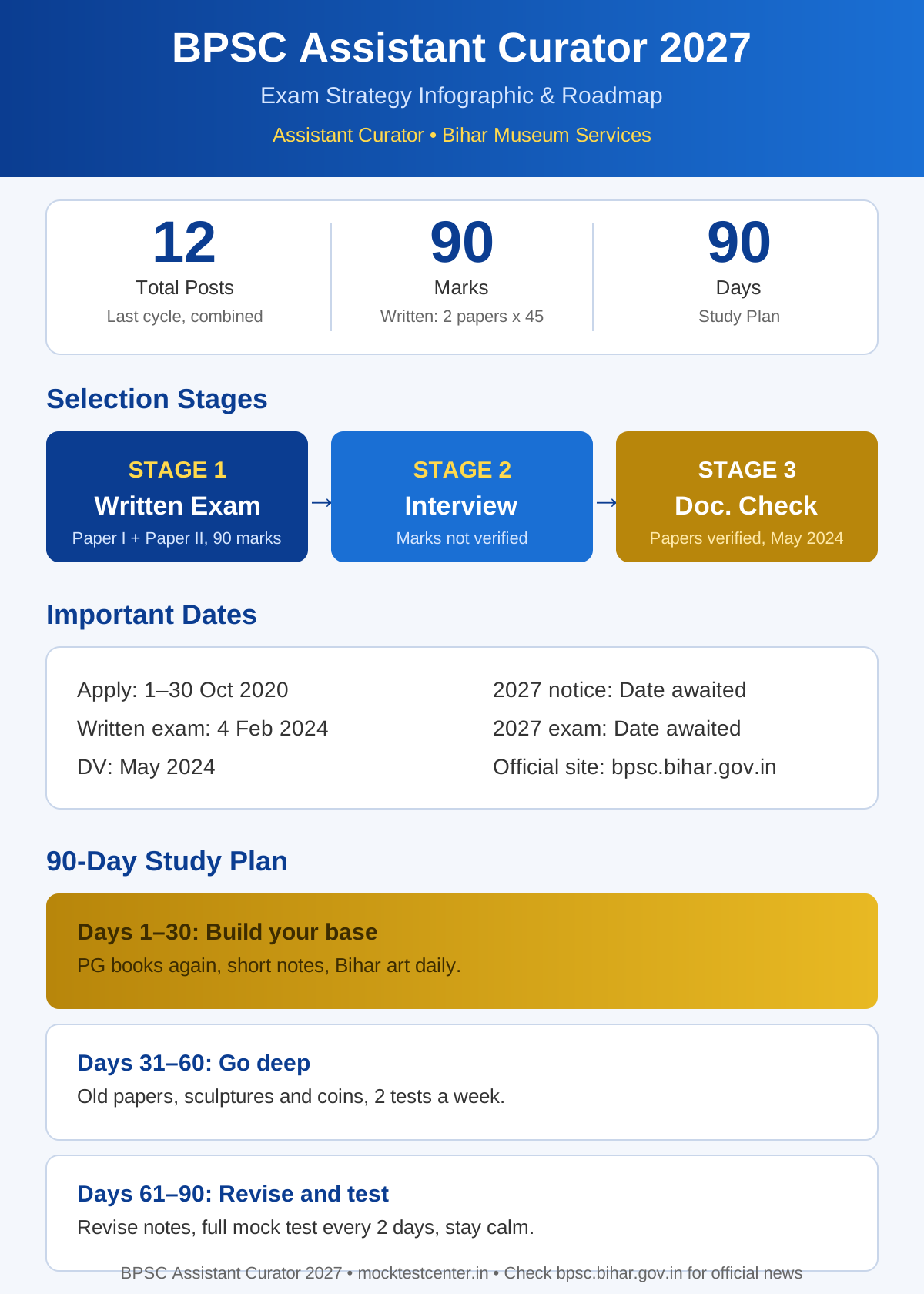
Vacancy means the number of empty posts. In the last cycle, the total was 12 posts, shared by three posts: Assistant Curator, Research and Publication Officer, and Assistant Director. Out of the 12 posts, 4 were kept for women. Twelve is a small number, and many history and archaeology post graduates will apply. A good plan and daily study can help you win one seat.
For 2027, the number of posts is not known yet, so we give no 2027 vacancy number here. No fresh 2027 notice for this post has been found in any source as of 18 November 2026. One site lists an Assistant Curator and Research and Publication Officer Examination of 2025 in its syllabus list, but no vacancy number or dates could be verified for it, so it is not used here.
| Post | Posts (last cycle) |
|---|---|
| Assistant Curator / Research & Publication Officer / Assistant Director (combined) | 12 (total, 4 for women) |
Exam pattern
Exam pattern means how the exam is set. The table shows the two papers. The pattern here is from the last cycle.
| Paper | Marks | Time | What it tests |
|---|---|---|---|
| Paper I – Ancient Indian History | 45 | 1 hour | Ancient Indian History, political and cultural |
| Paper II – Museum and Archaeology | 45 | 1 hour | Sculptures, inscriptions, coinage, museum and archaeology science |
| Written total | 90 | 2 hours | 90 objective questions |
| Interview | — | — | Face to face talk; marks not verified |
Both papers are objective type, with four choices per question. There is no negative marking in this exam, as reported in secondary sources. That means a wrong answer does not cut your marks, but you should still answer with care. Each paper has 45 marks and one hour.
After the written exam, shortlisted candidates are called for a personal interview. The interview marks were not verified in the sources read, so the article gives no interview marks. The last written exam was held on 4 February 2024 in two shifts. The pay is Rs. 47,600 to Rs. 1,51,000 per month, as reported in secondary sources.
Syllabus
Syllabus means the list of topics you must study. The official syllabus is in the notice on bpsc.bihar.gov.in. We give the broad topics here in simple words only.
- Paper I: ancient Indian history, with kings, kingdoms, politics, society, culture, art, and religion of old India.
- Paper II: sculptures of old India, inscriptions on stone and metal, old coins, and how a museum works.
- Paper II also has museum and archaeology science: how to dig, how to keep old things safe, and how to show them to visitors.
- Bihar focus: Nalanda, Vikramshila, Pataliputra, the Mauryan kings, and the old art of Bihar.
Study in a smart way. Your post graduate books are your best source, because both papers come from them. Learn the names of famous sculptures, inscriptions, and coins, and where they were found. Visit a museum if you can, and see how old things are kept and shown. Do not guess the syllabus from random videos.
Important dates
Write these dates in your diary. They are from the last cycle. The 2027 dates are not fixed yet.
| Event | Date |
|---|---|
| Official notice (last cycle) | Museum Services recruitment, 2020 |
| Apply online (last cycle) | 1 October 2020 to 30 October 2020 |
| Hard copy last date (last cycle) | 6 November 2020, 5.00 PM |
| Written exam (last cycle) | 4 February 2024 |
| Document Verification (last cycle) | May 2024 (last date extended to 15 May 2024) |
| New notice for 2027 | Date awaited (tentative) |
| 2027 written exam | Date awaited (tentative) |
Cut-off
Cut-off means the lowest marks that can pass a stage. If your marks are above the line, you pass. Each stage has its own cut-off. We give no cut-off number here, because none is verified for this exam. Cut-off marks change every year with the number of posts, the number of students, and how hard the paper is. With only 12 posts, the cut-off may be high, so aim high.
To score above the cut-off, do not leave easy marks in Paper I, because ancient history is your own subject. Learn sculptures, inscriptions, and coins well for Paper II. Since there is no negative marking, answer every question, but answer with care. Practice mock tests to learn time control: one hour for each paper.
Best books
Do not buy ten books for one topic. One good book is enough. Read it two times.
- Your post graduate books in ancient Indian history, archaeology, and art history.
- A book on Indian art, sculptures, inscriptions, and old coins.
- A book or notes on museology: how a museum works and how old things are kept safe.
- A good newspaper every day for current affairs.
No exact book title is given here. Ask your teacher or a senior who passed a BPSC exam which book helped them. Also solve the old papers of this exam if you can get them.
90-day study plan
Ninety days is about three months, enough time if you study every day. The plan has three parts of 30 days each.
Days 1 to 30: Build your base. Read your post graduate books again, make short notes, and learn the main kings, kingdoms, and art of old India. Read the news for 30 minutes each day. Give one small test each week.
Days 31 to 60: Go deep. Read each topic in more depth and solve old papers. Learn sculptures, inscriptions, and coins with their names and places. Practice 90 questions in one sitting. Give two mock tests each week and write your mistakes in a diary.
Days 61 to 90: Revise and test. Read your notes again and again. Do not start any new book now. Give a full mock test every two days, sitting for the full one hour for each paper like a real exam. Sleep well and keep your mind calm.
How to use mock tests
Mock tests are practice tests that look like the real exam. They show your weak topics, teach you time control (one hour for each paper), make you brave, and show your true score. Take mock tests on BPSC Assistant Curator 2027 at mocktestcenter.in. Start with one test each week, then two each week, and in the last month, one every two days. Always check your answers after a test and write the right answers in your notes.
Sit in a quiet room, keep your phone away, and use a clock. After each test, give one extra hour to your weakest topic. If Paper II is weak, read sculptures and coins again the same day. Mock tests work only if you check your errors and fix them.
A last word
The post of Assistant Curator is a good and respected government job for history and archaeology post graduates, with a pay of Rs. 47,600 to Rs. 1,51,000 per month as reported in secondary sources. The last cycle had only 12 posts and the last exam was held in February 2024, so the wait for a new notice is long, but that is not a reason to stop study. Start today. Do not wait for the new notice. Build your base, learn the art and coins of old India, and give mock tests. When the notice comes, read it on bpsc.bihar.gov.in and apply at once.